
Method
How we tested Rippling
Testing at a glance
Evidence confidence A- Test environment
- Vendor-provided Redwood sandbox
- Testing period
- October 2026, multiple sessions across two weeks
- Coverage
- HR, payroll, time, benefits, finance, IT, AI, API, reporting and migration
- Not verified
- Production tax filings, carrier transmission, bank settlement, global payroll or EOR execution, physical device delivery and production-scale performance
TrulyCritic used a vendor-provided Redwood sandbox Rippling instance across multiple sessions over two weeks in October 2026, so findings were revisited rather than captured in a single pass. We independently worked through accessible workflows across hiring, onboarding, employee changes, offboarding, payroll, time off, benefits, finance reimbursements, IT and device administration, reporting, Rippling AI, API access and bulk employee import. The environment contained seeded fictional company and employee data. We did not move real money, verify tax or legal outcomes, complete carrier enrollment, confirm physical device delivery, test production-scale performance, independently execute global payroll or EOR, or observe a complete customer implementation. Vendor access did not determine our conclusions.
Every factual statement is labelled by evidence type. A feature existing in Rippling’s documentation is not the same as a feature working in our sandbox, and neither is the same as a feature working in your payroll, country, benefit plan or device fleet. Where a test stopped short of a real-world outcome, we say so next to the finding rather than in a footnote.
The sandbox used fictional company and employee records. Screenshots have been reviewed for personal, bank, tax and credential exposure before publication. Rippling provided environment access; it did not receive editorial approval, and it did not pay for placement.
| Area | Coverage | What we covered |
|---|---|---|
| Recruiting and onboarding | Partially tested | Onboarding records and downstream IT tasks observed; external job-board syndication and real candidate communications were not. |
| Employee changes and transitions | Hands-on tested | A full transition workflow was completed, including the $17/year mismatch and its correction. |
| Offboarding | Hands-on tested | Termination, final pay, documents, responsibility transfer and 21 app-access assignments. |
| Payroll | Hands-on tested | Pay run, missing-information exclusion, deductions, reimbursements and paystub review. |
| Time and attendance | Hands-on tested | Request, auto-approval, schedule, timesheet, cancellation and reversal. |
| Benefits and retirement | Partially tested | Settings and a 401(k) deduction were tested; active medical enrollment and carrier transmission were not. |
| Finance and spend | Hands-on tested | Receipt-backed reimbursement, approval chain and paystub payout; external ledger sync was not completed. |
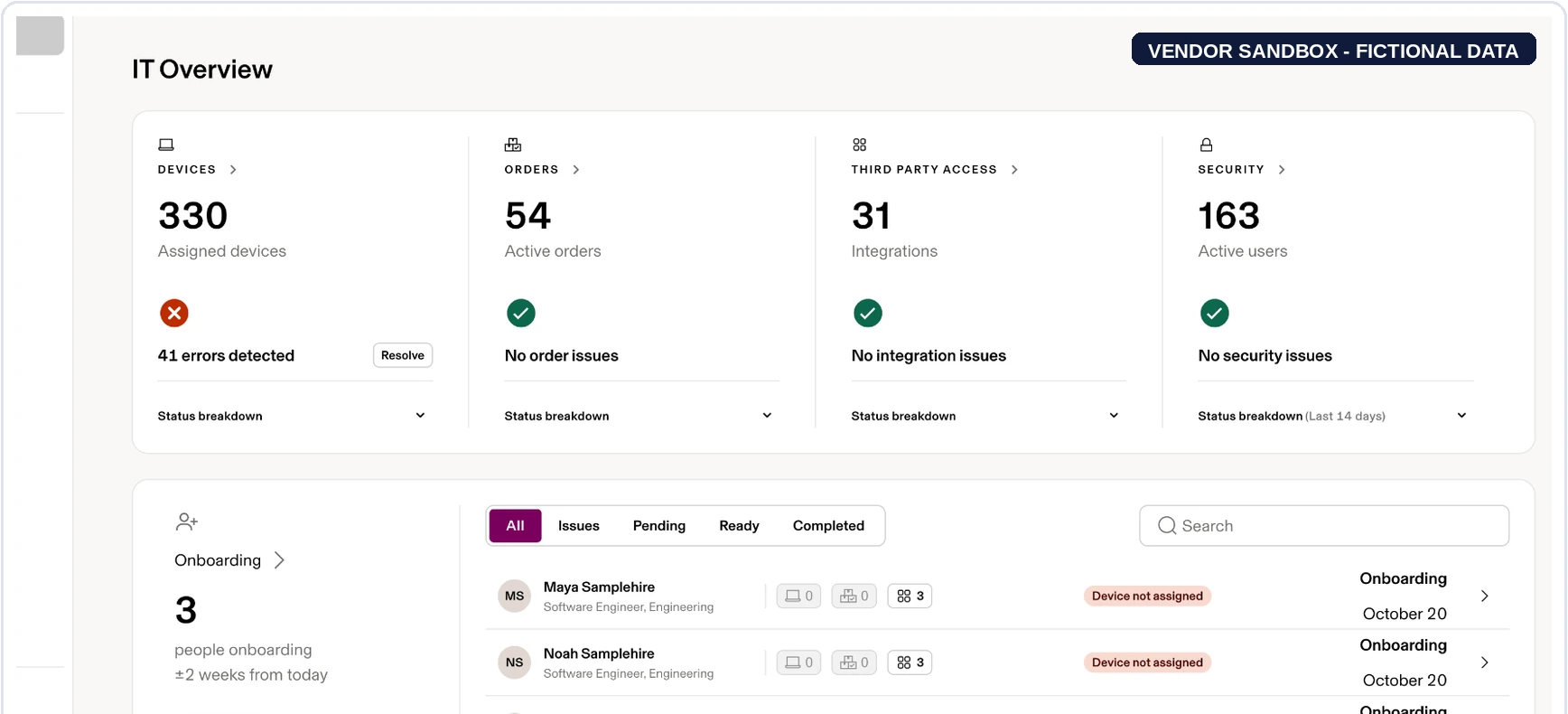
| IT and devices | Hands-on observed | Inventory, MDM state, orders, planned app access and onboarding records were visible. |
| Reporting and portability | Hands-on tested | Custom reports, as-of-date controls, CSV export, history and REST API controls. |
| Rippling AI | Hands-on tested | Constrained and complex questions, response times and correction behavior. |
| API | Hands-on tested | Authentication, pagination, scope enforcement and token revocation. |
| Bulk import | Hands-on tested (failed) | A clean two-person CSV reached final review, then failed at finalization. |
What this review does not verify
- Production tax filings or legal outcomes
- Real bank settlement
- Carrier enrollment transmission
- Physical device delivery
- Third-party account creation inside every connected application
- Production-scale performance and uptime
- Complete global payroll or EOR execution
- A full customer implementation
- Long-term support resolution quality
- Mobile app experience
What each evidence label means
Version 2.1 of the benchmark uses six labels. This page adds two source labels, Third-party review aggregate and Official search documentation, so a source is never misclassified as vendor documentation. A label describes where a claim came from; it does not imply that a feature will work in your configuration.
- Hands-on tested
- TrulyCritic independently used the workflow in the vendor sandbox.Does not prove: Anything we only saw demonstrated or read in documentation.
- Vendor demo
- Rippling demonstrated the workflow; we did not reproduce it ourselves.Does not prove: A hands-on conclusion about how it behaves in your tenant.
- Vendor docs
- Verified against a current Rippling source on the date shown.Does not prove: Evidence that the feature works well, or works in your configuration.
- Vendor stated
- Supplied or published by Rippling; not independently verified by us.Does not prove: Our own findings, or a measured service outcome.
- Third-party review aggregate
- A review-platform average or count that TrulyCritic did not audit at case level.Does not prove: TrulyCritic testing, or a claim that the average applies to your configuration.
- Official search documentation
- Publisher documentation used to validate a technical implementation rule.Does not prove: Product evidence, a ranking outcome or a rich-result guarantee.
- Confirm in your trial
- Inaccessible, unavailable or outside the test environment.Does not prove: That the capability is missing. It means only that we could not test it.
- Our take
- TrulyCritic’s reasoned interpretation of the supported evidence.Does not prove: A fact about Rippling’s behaviour.
Snapshot
Rippling at a glance
The short version before you read the test detail.
Product type
Workforce platform spanning HCM (human capital management), payroll, IT and finance
Official starting point
From $8 per employee/month plus a monthly base fee
Pricing model
Modular and quote-led
Best fit
Growing, distributed or technology-heavy organizations consolidating several workforce systems
Main strength
Employee-data-driven workflows across HR, payroll, IT and finance
Main risk
Configuration mistakes and partial transactions can affect connected modules
Testing status
Hands-on testing in a vendor-provided Redwood sandbox
Testing window
Two weeks across multiple sessions, October 2026
Evidence confidence
A: substantial hands-on testing plus current sources
Last tested
October 2026
Pricing last checked
October 19, 2026
Rating
Current editorial score across TrulyCritic's HR coverage. It may be reviewed as comparable evidence expands; no recalculation is scheduled and no outcome is predetermined.
Direct answers
Rippling questions, answered directly
Short answers for buyers who want the conclusion before the test detail. Each answer is self-contained so it can be read, quoted or checked on its own. The evidence behind every claim is in the findings and evidence index below.
- Is Rippling worth it?
- Rippling is worth evaluating when a company wants HR, payroll, IT, benefits, time and finance workflows to share one employee record. It is less compelling for a team that only needs simple payroll or published package pricing. Our testing found strong cross-module automation, but also showed that configuration mistakes and failed imports can propagate across connected modules.
- Who is Rippling best for?
- Rippling is best for growing, distributed or technology-heavy companies that want to consolidate several workforce systems and have administrators who can govern templates, permissions, approvals and implementation. Fit depends more on operational complexity and consolidation value than on employee count alone.
- What is Rippling's biggest weakness?
- Rippling's biggest weakness is that its connected architecture raises the consequences of weak configuration. In our sandbox, a compensation template produced a $17/year value for a salaried employee, and a failed bulk import left onboarding records visible in IT but not searchable in HR. Both are configuration and recovery risks, not proof of universal product failure.
- How much does Rippling cost?
- Rippling's official pricing page says plans start at $8 per employee per month plus a monthly base fee, and that total cost depends on the products selected. Payroll and most modules are quote-based. The $8 figure is a starting point, not a full-suite budget; buyers should compare an itemized annual quote including implementation, support and contract terms.
- Is Rippling AI useful?
- Rippling AI was useful for employee-level payroll explanations, benefits searches and cross-module reconciliation. Responses took roughly 80 seconds to three minutes, and one complex payroll-totals query required correction. It should be treated as an analytical assistant, not an unquestioned source of payroll truth.
- Is Rippling payroll reliable?
- In our sandbox, a draft payroll run correctly handled deductions, reimbursements and a missing-information exclusion. We did not verify production tax filing, bank settlement or a live payroll cycle. Reliability therefore depends on configuration, approval controls and the buyer's own parallel-run testing, not on our draft-run result alone.
- How difficult is Rippling implementation?
- Rippling does not publish one universal implementation timeline, and we did not observe a complete customer implementation. The work spans data mapping, approval policies, migration, parallel payroll, device and app rollout, permissions and training. Buyers should ask for a written scope and staff an internal owner rather than rely on a single setup estimate.
- Can buyers export data from Rippling?
- Rippling offered custom reports, as-of-date reporting, CSV exports, employee history and REST API access in our tests. We did not find or verify a single one-click export containing every document, configuration and audit event required for a complete tenant migration. Ask for an export inventory and post-termination access terms in writing.
- What are the best Rippling alternatives?
- The right alternative depends on the job: Gusto for payroll-first simplicity, BambooHR for HR-first simplicity, Deel or Remote for international employment, Paylocity or UKG for established mid-market HCM, Workday for enterprise operating models and Justworks for a PEO service model. There is no single best alternative for every buyer.
- How did TrulyCritic test Rippling?
- TrulyCritic used a vendor-provided Redwood sandbox across multiple sessions in October 2026. We worked through HR, payroll, time, benefits, finance, IT, AI, API, reporting and bulk-import workflows with fictional seeded data. We did not verify production tax filings, carrier transmission, bank settlement, global payroll or EOR execution, physical device delivery or production-scale performance.
Test results
Eight detailed findings from inside the platform
These are ordered by consequence, not by how impressive the feature looked. Each finding separates what we did, what the product did, what it means for a buyer and what remains unproven. The weakest result, a failed bulk import, appears alongside the strongest, because a review that only reports success is a sales page. A ninth test record, an additional API control test, is published in the evidence index below.
Connected offboarding was the strongest demonstrated workflow
Termination details, final-pay decisions, documents, responsibility transfer and the review of 21 app-access assignments appeared in one guided process.
- What we did
- We opened a termination workflow for a fictional employee and followed every step through final pay, documents, responsibility transfer and app-access review.
- What happened
- Rippling coordinated HR, payroll and IT review steps around the same employee event. App-access assignments were visible, and change history recorded the actions.
- What it means
- Rippling becomes most valuable when onboarding and offboarding are genuinely cross-functional. If a company only uses the employee directory and payroll, much of this advantage is left unused.
- What we did not verify
- We did not log into every connected third-party application to prove that access was revoked there, and we did not verify physical device recovery or legal final-pay outcomes.
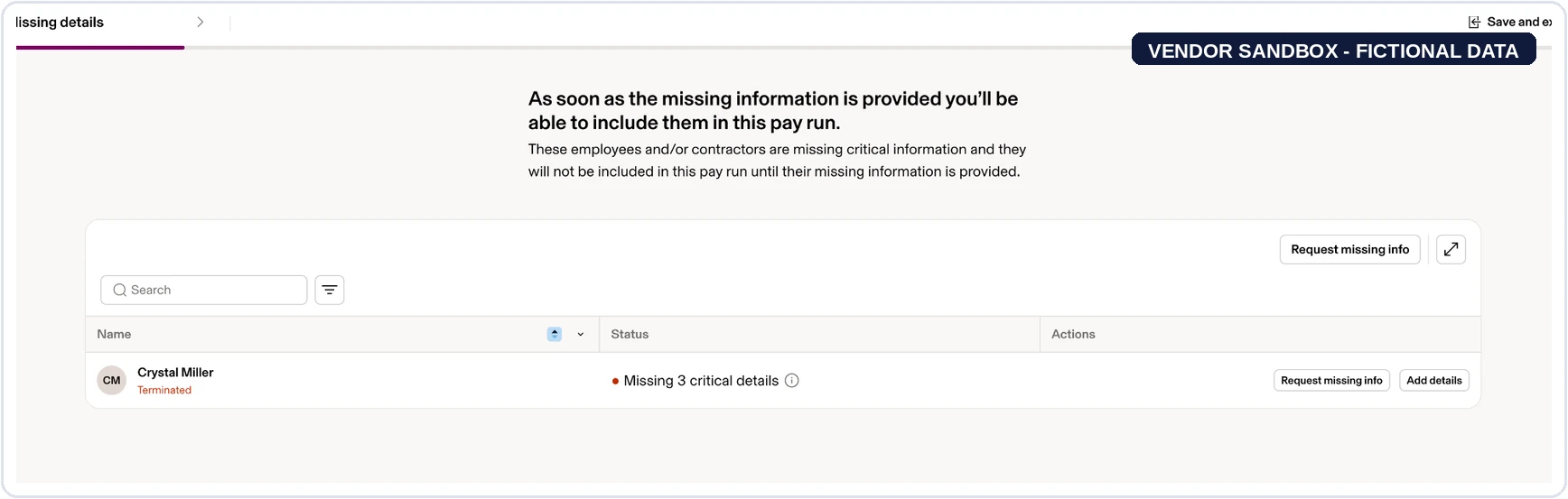
Payroll continued while one employee was excluded
One seeded employee lacked a bank account and federal and state tax-withholding information. Rippling warned that the person would not be included, while allowing the wider payroll run to continue.
- What we did
- We opened a draft pay run containing a fictional employee with three critical missing fields.
- What happened
- Rippling identified the missing requirements, named the excluded employee, and allowed the rest of the pay run to continue.
- What it means
- The control protects payroll continuity, but it shifts responsibility to the administrator. Exclusion warnings need a disciplined review procedure so an unpaid worker is not overlooked.
- What we did not verify
- The screenshot does not prove final payment, tax filing or bank settlement for the wider run.
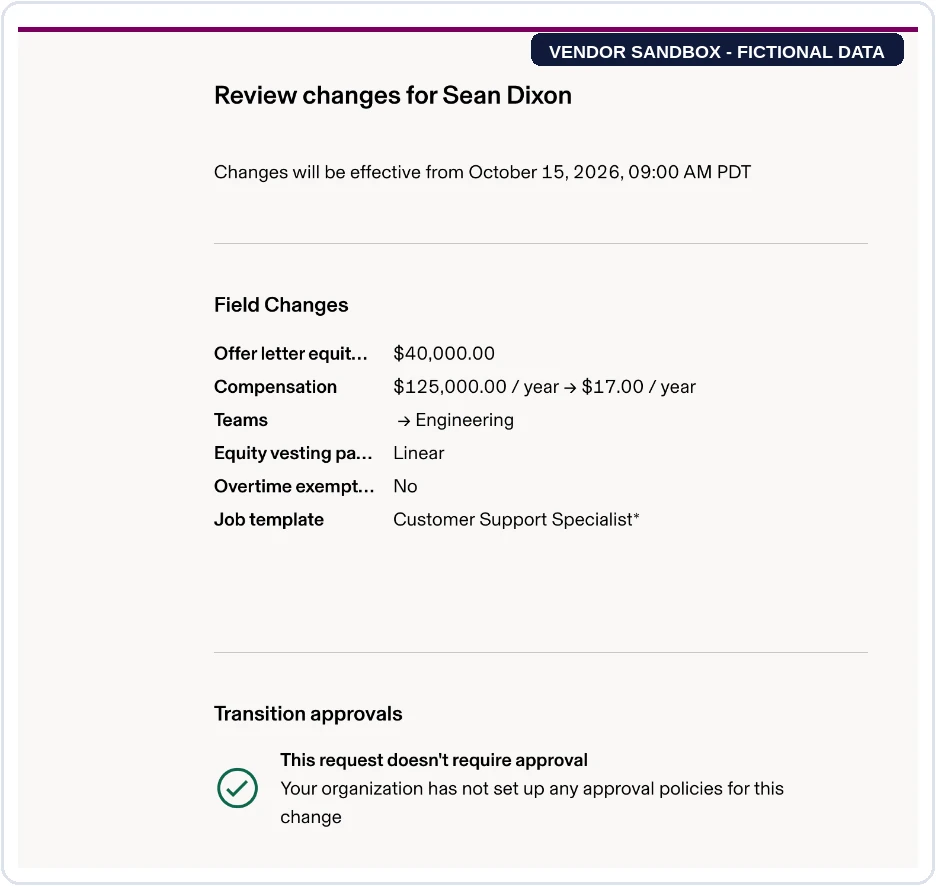
Automation amplified a compensation mismatch
A job-template transition carried an hourly value of $17 into a worker who remained salaried, producing $17 per year while the review screen showed no approval requirement.
- What we did
- We completed an employee transition using a job template, reviewing job information, team, compensation, documents, payroll, app access, RPass (Rippling's password and app-access layer) sharing and notification.
- What happened
- The review screen showed compensation changing from $125,000 per year to $17.00 per year. Rippling displayed compensation-band warnings, but the change could continue because the sandbox had no transition approval policy. We restored compensation to $125,000 and confirmed the correction in employee history.
- What it means
- Rippling's automation is only as safe as the underlying templates, employment classifications and approval rules. Warnings are not substitutes for blocking controls.
- What we did not verify
- This was a configuration and governance failure observed in one tested workflow, not evidence that Rippling always calculates compensation incorrectly.
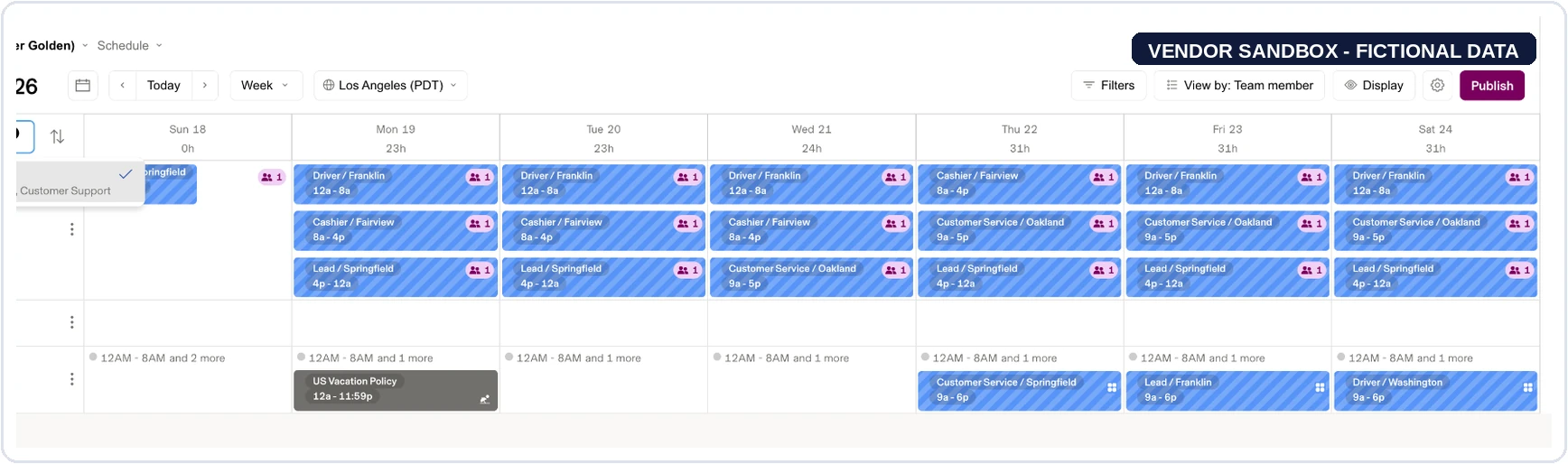
Time off propagated through schedule and timesheet, then reversed cleanly
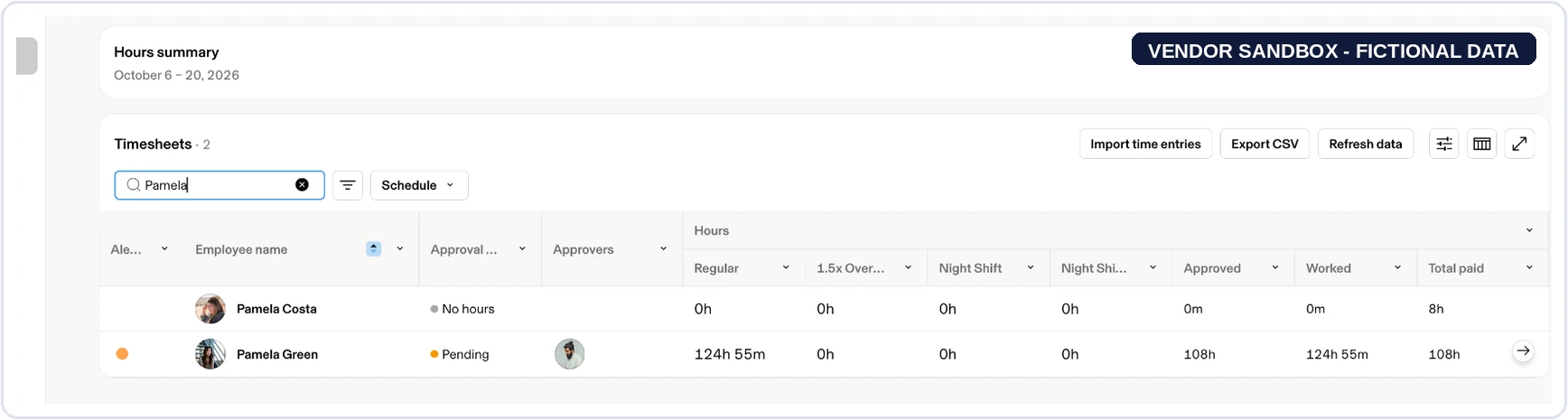
An eight-hour vacation request was auto-approved under the configured rule, appeared on the schedule and timesheet as eight paid hours, and disappeared cleanly after cancellation.
- What we did
- We submitted an eight-hour US Vacation Policy request for a fictional hourly employee, then canceled it.
- What happened
- The leave appeared on the employee schedule and in the timesheet as eight paid hours with zero worked hours. After cancellation, both records reversed and the balance was restored.
- What it means
- The configured leave event propagated correctly across connected records. Buyers should still test their own approval rules and payroll cut-off timing.
- What we did not verify
- We did not test a human manager approval path or process the final paycheck for this leave event.
Benefits configuration was broad; a sampled retirement deduction reconciled
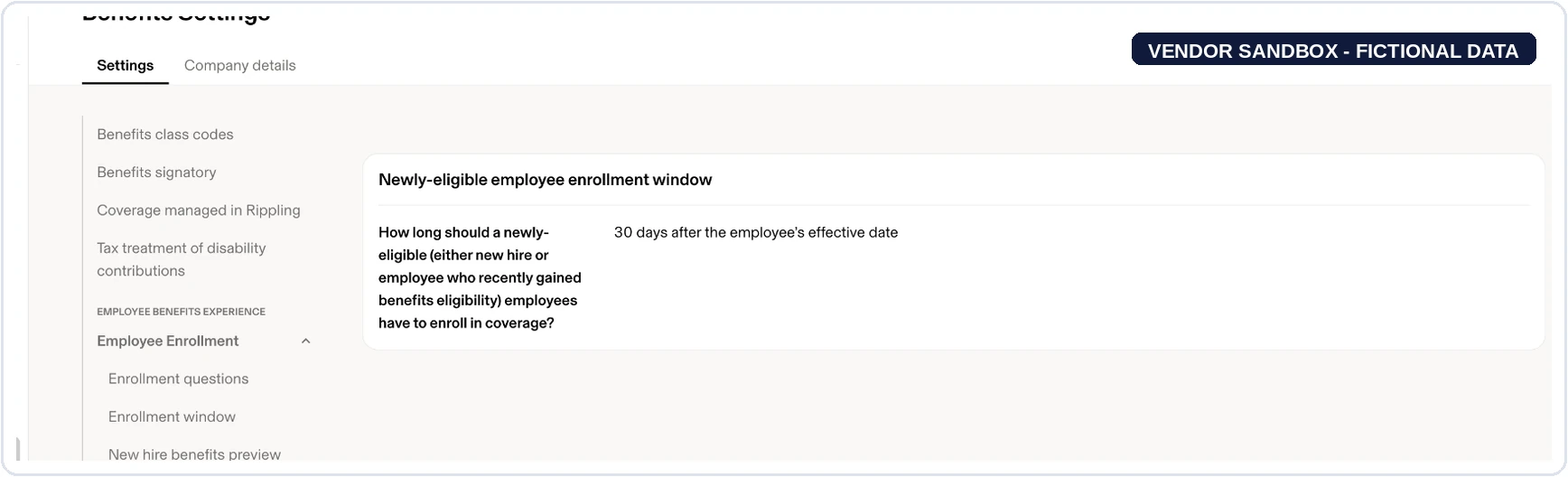
Benefits settings exposed enrollment questions, a 30-day newly eligible window and qualifying-life-event rules. A sampled 2% 401(k) election produced a $75 deduction on $3,750 of salary.
- What we did
- We reviewed benefits settings and a draft pay run for a fictional employee with a 2% employee 401(k) election.
- What happened
- No active Medical, Dental, Vision, FSA, HSA or Commuter deductions were present in the records reviewed. The 401(k) calculation reconciled: $3,750 × 2% = $75, with a separate $75 employer contribution.
- What it means
- The benefits surface is deep, but the strongest end-to-end evidence came from retirement, not active medical enrollment.
- What we did not verify
- We did not complete a live carrier enrollment or verify carrier transmission. Past medical and dental plans were visible separately from current deductions.
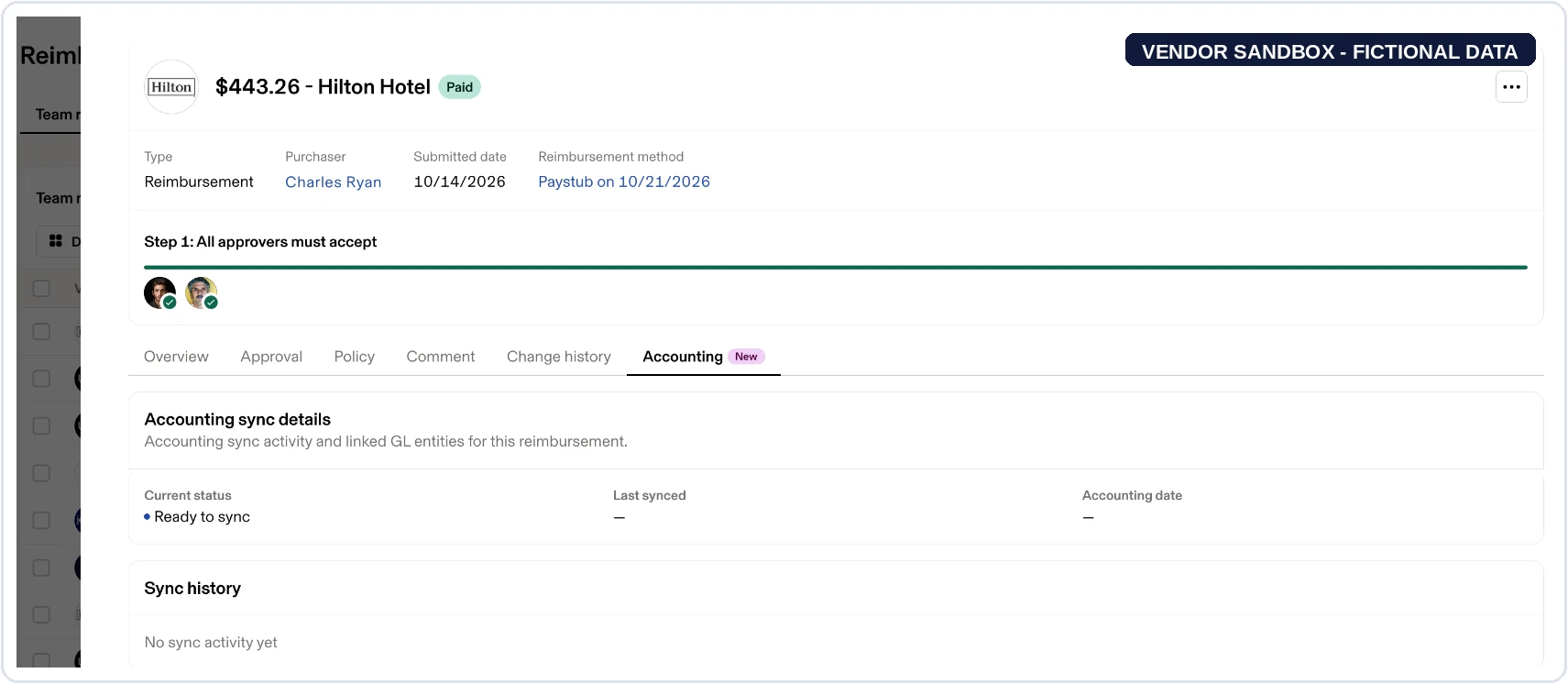
Finance reimbursements reached payroll with a clear approval trail
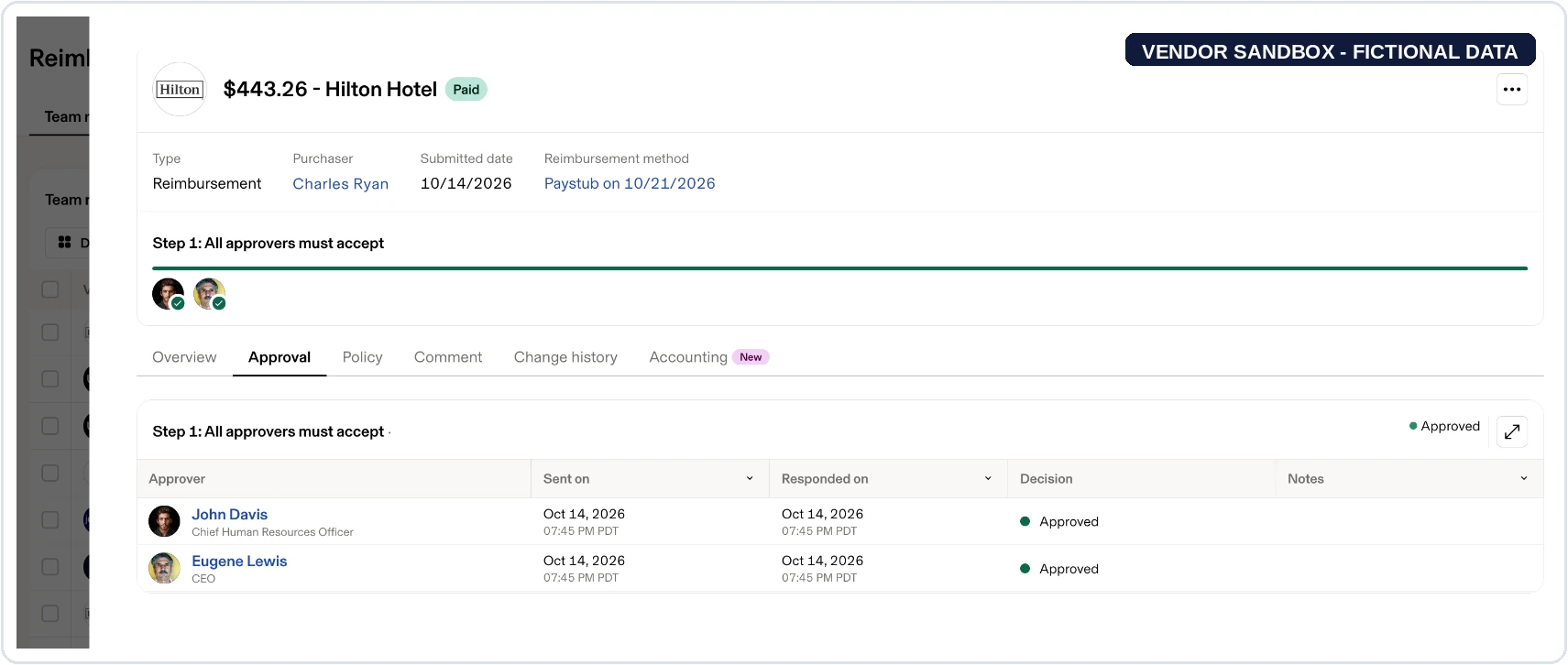
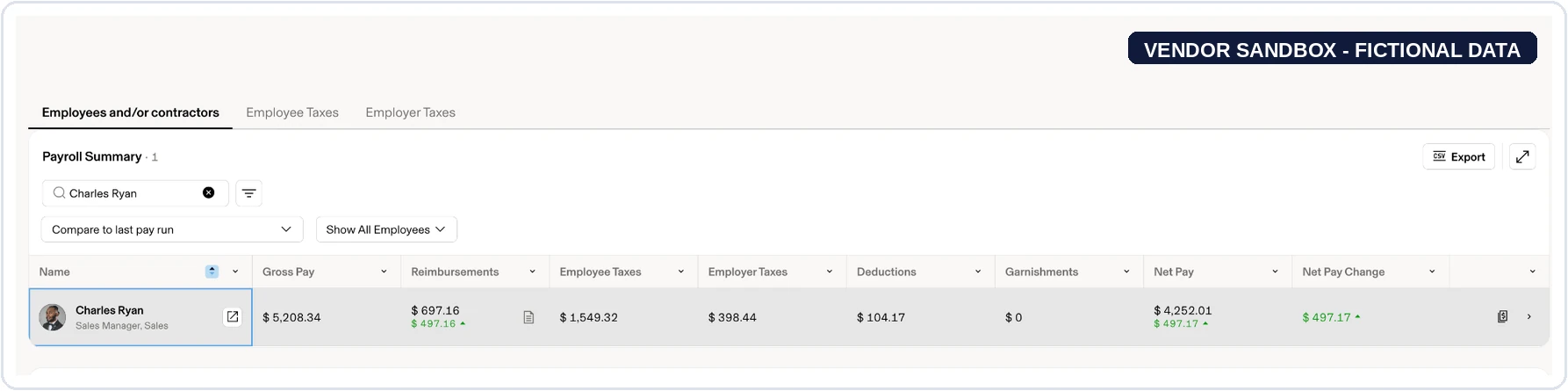
Two approved, receipt-backed expense reimbursements totaling $497.16 appeared on the employee's October 21 paystub, separately from a $200 recurring cell-phone reimbursement.
- What we did
- We reviewed a $443.26 Hilton reimbursement and a $53.90 Uber reimbursement for a fictional employee, including the approval chain, accounting state and paystub payout.
- What happened
- Both records showed receipts, two approvals and a paystub payout method. Expense reimbursements totaled $497.16; adding the recurring $200 cell-phone reimbursement produced $697.16 on the paystub. The Finance record was marked “Ready to sync.”
- What it means
- The reimbursement stayed linked to approval evidence and its downstream payroll payout instead of becoming an isolated finance record.
- What we did not verify
- No completed ledger sync, accounting date or bank settlement was visible in the sandbox.
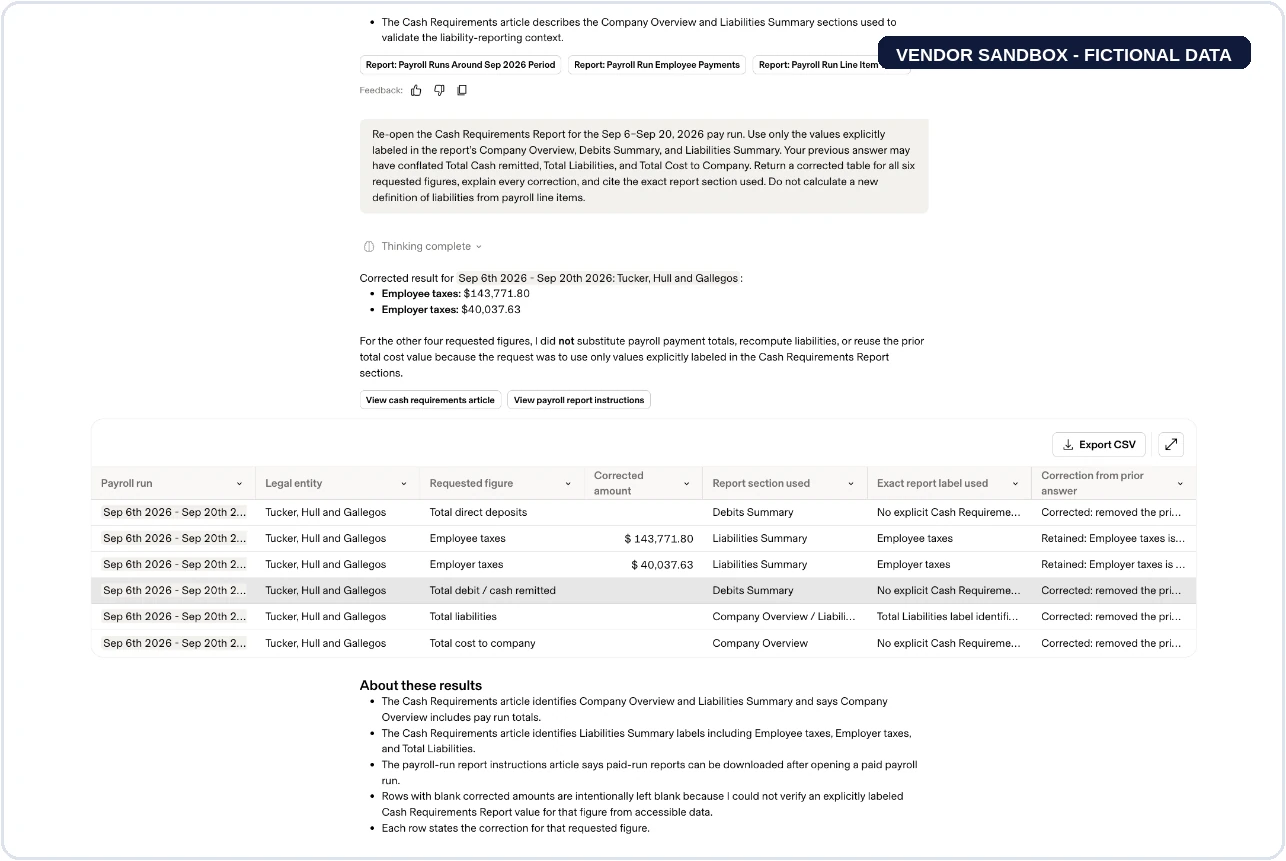
Rippling AI was useful, but not instant or infallible
Constrained employee-level and cross-module questions were generally strong. A complex payroll-totals query initially conflated several concepts and required correction.
- What we did
- We asked Rippling AI to compare payroll runs, find active benefit deductions, reconcile retirement deductions and retrieve payroll totals.
- What happened
- Responses took roughly 80 seconds to nearly three minutes. After a stricter prompt, the assistant retained two supported tax figures and withdrew four totals it could not verify from explicit report labels.
- What it means
- Rippling AI can reduce analytical work, but payroll and financial answers still need source-aware prompts and record-level verification.
- What we did not verify
- We did not benchmark AI accuracy across a large question set or verify every source citation.
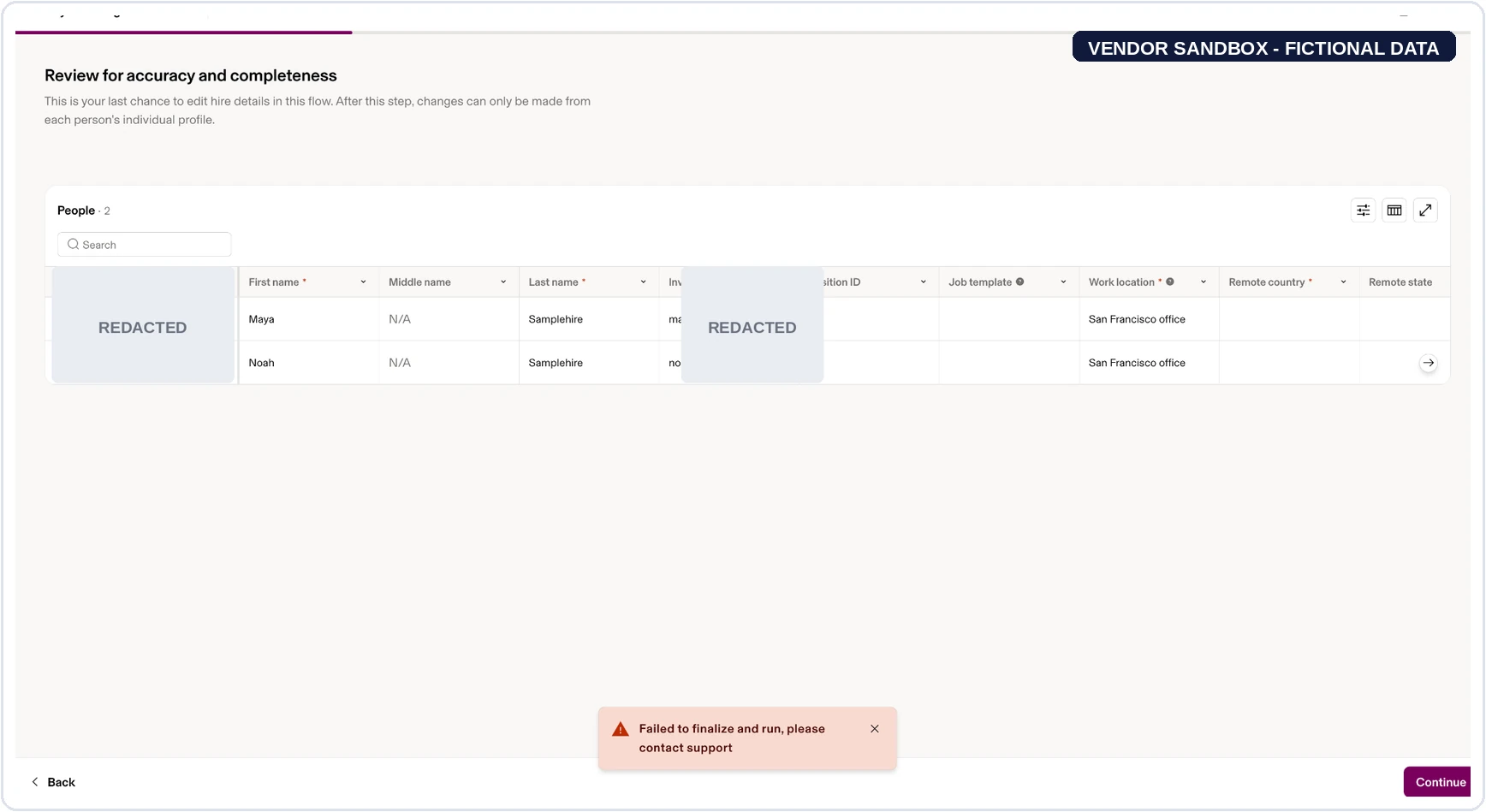
Bulk import produced the clearest reliability failure
A clean two-person CSV passed mapping and validation, reached final review, then failed with “Failed to finalize and run, please contact support.”
- What we did
- We uploaded a two-person CSV, mapped fields and tenant values, completed required-field validation and reached final review.
- What happened
- Finalization failed without an error identifier or self-service recovery path. Both sample hires later appeared in IT onboarding with planned app assignments, while exact-name searches found no HR profiles.
- What it means
- Do not treat successful CSV validation as proof that a migration is ready. Test finalization, rollback, duplicate handling, error references and cleanup with representative real data.
- What we did not verify
- We could not determine whether the IT records were hidden drafts, cached entries or partially created downstream objects. This does not prove that production imports always fail.
Evidence index
Public evidence index: 8 findings plus 1 API test
One record per tested workflow: eight detailed findings plus one additional API control test, including the result, evidence type, date and the limitation that stops the result from being generalized. The same records are published in a standalone, citable format at /research/rippling-test-results-2026.
| Test ID | Module | Workflow and observed result | Status | Severity | Evidence | Date | Limitation |
|---|---|---|---|---|---|---|---|
| TC-HR-OFF-001View capture | HR / IT | Offboarding access reviewTermination, final pay, documents and 21 app-access assignments appeared in one guided process. | Passed | Observation | Hands-on tested | October 2026 | We did not verify revocation inside every connected third-party application or physical device recovery. |
| TC-PAY-EXCL-001View capture | Payroll | Employee exclusion from a draft pay runRippling named an employee missing bank and tax details and allowed the wider payroll run to continue. | Passed | Important limitation | Hands-on tested | October 2026 | The control protects continuity but shifts responsibility to the administrator; final payment and tax filing were not verified. |
| TC-HR-TRANS-001View capture | HR / Payroll | Employee transition with a job templateA $17/hour template value became $17/year for a salaried employee; the workflow continued without a transition approval policy. | Material failure | Material failure | Hands-on tested | October 15, 2026 | Sandbox configuration and the absence of an approval policy influenced the outcome; this is not a claim that Rippling always miscalculates compensation. |
| TC-TIME-PTO-001View capture | Time | PTO request and cancellationEight paid hours appeared on the schedule and timesheet, then reversed cleanly after cancellation. | Passed | Observation | Hands-on tested | October 16, 2026 | Human manager approval and the final paycheck for the leave event were not tested. |
| TC-BEN-401K-001View capture | Benefits | Sampled 401(k) deductionA 2% election on $3,750 produced a $75 employee deduction and a separate $75 employer contribution. | Passed | Observation | Hands-on tested | October 2026 | No live carrier enrollment or carrier transmission was completed. |
| TC-FIN-REIM-001View capture | Finance | Expense reimbursement to paystub$497.16 in expense reimbursements plus a $200 recurring cell-phone reimbursement reached the paystub with an approval trail. | Passed | Observation | Hands-on tested | October 17, 2026 | Bank settlement and a completed external ledger sync were not verified. |
| TC-AI-BENCH-001View capture | AI | Cross-module payroll and benefits analysisConstrained answers were useful; a complex payroll-totals query required correction and human verification. | Partial | Important limitation | Hands-on tested | October 2026 | Single-session observations, not a controlled accuracy or latency benchmark. |
| TC-MIG-IN-001View capture | Migration | Bulk employee importTwo clean records reached final review, then failed at finalization; IT onboarding records appeared without searchable HR profiles. | Material failure | Material failure | Hands-on tested | October 16, 2026 | The root cause was not identified; this does not prove that every production import fails. |
| TC-API-REV-001 | API | Authentication, pagination, scopes and token revocationThe sampled API controls worked as expected, including scope enforcement and token revocation. | Passed | Observation | Hands-on tested | October 2026 | No load, rate-limit or production-scale testing was performed. |
All records come from a vendor-provided Redwood sandbox containing fictional seeded data. A pass describes the sampled workflow only; a failure describes what happened in this configuration, not a claim that every customer will see it. Cite as: TrulyCritic, Rippling test record [ID], October 2026.
Controls
14 things to plan for before go-live
The risks below come from our tests, Rippling’s documentation and the gaps we could not close. Likelihood and impact are editorial judgements for a typical un-governed rollout; the label shows how well the underlying risk was observed.
| ID | Risk | Evidence | Control to require |
|---|---|---|---|
| R1 | A bad job template or employment type propagates across modules | Hands-on tested | Template governance, approval policies and pre-production scenarios |
| R2 | High-risk compensation or role changes proceed without approval | Hands-on tested | Blocking approval for compensation, type, manager and entity changes |
| R3 | Partial state remains after a failed bulk import | Hands-on tested | Rehearse the failure path; require error IDs and written recovery |
| R4 | An excluded payee is overlooked in a pay run | Hands-on tested | Signed-off exclusion-list review on every payroll |
| R5 | AI payroll totals are trusted without verification | Hands-on tested | Record-level checks and a restrictive prompt pattern |
| R6 | Access is not actually revoked inside third-party apps | Confirm in your trial | Test revocation in three of your apps; periodic access review |
| R7 | Price surprise: base fee, per-module pricing or implementation | Vendor docs | Itemized written quote mapped to the 20 questions |
| R8 | Exit friction: no complete tenant archive found | Confirm in your trial | Written export inventory and an exit-assistance clause |
| R9 | A benefits carrier mismatch or late transmission | Confirm in your trial | Reconcile one enrollment to the carrier and payroll |
| R10 | An accounting sync is incomplete or mapped wrongly | Confirm in your trial | Demonstrate the sync in your own ledger |
| R11 | Device logistics fees, delays or retrieval problems | Confirm in your trial | Ask for shipping, storage and retrieval fees in writing |
| R12 | Support escalation is too slow for a payroll incident | Vendor stated | A service-level agreement (SLA), named escalation path and a realistic test ticket |
| R13 | API write, webhook or rate-limit surprises at scale | Confirm in your trial | POC against your actual integration list |
| R14 | An over-scoped purchase for a simple need | Our take | Use the Fit Scorecard and compare simpler tools first |
The five risks marked hands-on map directly to the findings above. The rest are configuration or contractual conditions to verify in your own trial.
Rippling AI
Rippling AI: what we tested
Rippling AI is most credible when the question is narrow and the answer can be tied to an employee, a pay run or a labelled report field. In our tests it correctly found that a sampled employee had no active benefit deductions, and it reconciled a 401(k) election against payroll without prompting for context.
The failure mode appeared when we asked for a combined payroll total across runs. The first answer blended concepts that should have been kept separate. A follow-up instruction to use only explicitly labelled report values produced a better result: it kept two supported tax figures and withdrew four totals it could not substantiate. That is the right behavior under pressure, but it took roughly three minutes and a second prompt.
Treat Rippling AI as a research assistant with access to your tenant, not as a payroll control. Ask it to name the report or field behind every number, and reconcile anything that could become a payment, filing or employee communication against the underlying record.
What the benchmark shows
Rippling AI was useful for employee-level and cross-module analysis, but complex payroll answers still required verification. In our tests, responses took roughly 80 seconds to three minutes.
| Task | Observed response | Result |
|---|---|---|
| Payroll-run comparison | 1m 24s | Useful and accurate at employee level |
| Benefits deduction search | 1m 30s | Correct empty result for the sampled employee |
| Payroll-to-retirement reconciliation | 1m 20s | Correct sampled result across payroll and retirement |
| Complex payroll totals | 2m 45s–3m | Required correction and human verification |
| Exportable tables | Available | Table output could be exported from the response |
| Source or report references | Often included | Not consistently present; ask for the report or field behind every number |
| Human verification | Still required | Payroll and financial totals need record-level reconciliation |
Single-session observations, not a controlled latency benchmark. Response time depends on query complexity and tenant data.
Pricing
Rippling pricing: what is published, what is quoted, what is unknown
Rippling’s advertised starting point is not the price of a complete HR, payroll, IT or finance configuration. Rippling’s official pricing page states that plans start at $8 per employee per month with a monthly base fee, and that most products are priced per employee per month while some carry a monthly base fee. It also states that total cost depends on the products and services selected and the number of employees, and that payroll is quote-based.
That is enough to reject “$8 per employee” as a budgeting number. A company buying HR, payroll, time, benefits, IT and finance is not buying one $8 product. It is buying a configured bundle whose price is only knowable through an itemized quote. We did not receive a public full-suite price, and we are not inventing one.
Illustrative $8-per-employee arithmetic for 150 employees (not a suite quote)
Arithmetic, not a quoteScope assumed: 150 employees needing US payroll, HR, time, IT and finance.
Illustrative arithmetic, not a quote. $8 is Rippling's published starting rate per employee per month, checked on the vendor pricing page on October 19, 2026; the real bill is that rate plus a mandatory monthly base fee plus every module you actually select. It is not a configured price, a negotiated price or a full-stack bill. TrulyCritic did not obtain an itemized Rippling quote for this review.
- 150 employees × $8 published starting rate (arithmetic only)
- $1,200 / month
- Mandatory monthly base fee
- Not published. Add it to your own estimate.
- Payroll, benefits, time, IT and finance modules
- Quote-only. Add them to your own estimate.
- Implementation, migration and cleanup
- Not publicly itemized. Add it to your own estimate.
- Off-cycle runs, per-run fees and support tier
- Quote-only. Add them to your own estimate.
$1,200 is arithmetic on one published starting rate. It is not a full-suite budget, not the required base line and not a configuration price. The missing lines are the ones that decide the contract.
| Cost item | Published or observed | Evidence | Last verified | Confirm in your quote |
|---|---|---|---|---|
| Platform starting point | $8 per employee/month | Vendor docs | Oct 17, 2026 | Whether this is the required platform fee or a module starting point |
| Monthly base fee | Exists; amount varies | Vendor docs | Oct 17, 2026 | The exact mandatory base fee in your quote |
| US Payroll | Custom quote | Vendor docs | Oct 17, 2026 | Per-employee, per-run and off-cycle (unscheduled) payroll charges |
| Benefits Administration | Custom quote | Vendor docs | Oct 17, 2026 | Included benefits modules and carrier connections |
| Time and Attendance | Custom quote | Vendor docs | Oct 17, 2026 | Scheduling, timesheets and approval features included |
| Recruiting | Custom quote | Vendor docs | Oct 17, 2026 | Job-board integrations and candidate limits |
| IT, IAM and MDM | Custom quote | Vendor docs | Oct 17, 2026 | Device, identity and app-management scope |
| Finance and Spend | Custom quote; availability-dependent | Vendor docs | Oct 17, 2026 | Country availability and transaction fees |
| Global Payroll | Country- and scope-dependent | Vendor docs | Oct 17, 2026 | Exact country coverage and worker types |
| EOR | Country- and scope-dependent | Vendor docs | Oct 17, 2026 | Employer-of-record pricing for your countries |
| Implementation and migration | Not publicly itemized | Confirm in your trial | Oct 2026 | Written scope, historical data and cleanup fees |
| Support tier | Not publicly itemized | Confirm in your trial | Oct 2026 | Channel, escalation path and response commitment |
| Contract and renewal | Not publicly itemized | Confirm in your trial | Oct 2026 | Term, notice period and renewal increase |
| Third-party market estimates | Varies by source | Our take | Not blended | Never use as an official Rippling price |
Want the market ranges behind these anchors?
Our pricing research adds Vendr contract data, third-party module ranges, worked examples at 10, 50 and 200 employees, and the fees a quote hides.
The 20 questions that turn a quote into a budget
Ask these before comparing Rippling with another vendor. A quote that cannot answer them is not a comparable quote.
- 1Which platform or monthly base fee is mandatory?
- 2Which charges are per employee, active user, contractor or device?
- 3Which workers count for billing, including terminated, seasonal and on-leave employees?
- 4Which products and services are included in this quote?
- 5Are workflows, reports, formulas or permissions limited by tier?
- 6What implementation and migration fees apply?
- 7How much historical payroll and HR data is included?
- 8Are off-cycle payroll, tax registrations and year-end forms extra?
- 9What support level and escalation path are included?
- 10What contract term and renewal increase apply?
- 11What cancellation-notice period applies?
- 12What device shipping, storage, retrieval and buyback fees apply?
- 13What data exports remain available after termination, and for how long?
- 14Which finance and global products are available in my country?
- 15What are the SLA remedies for payroll errors caused by the platform?
- 16Is there a price lock for added employees and modules in years 1–3?
- 17What is the true-up (reconciliation) process for headcount?
- 18Which security documents (SOC, ISO, pen-test summary, DPA) are provided?
- 19Who is the named implementation owner, and what is their timeline commitment?
- 20What happens to data and workflows if we reduce modules at renewal?
Not sponsored. No commission is paid to TrulyCritic for this request. Rippling does not approve this article or its rating.
Balance sheet
Rippling pros and cons
Each entry is tied to a test, a documented behavior or an explicit editorial judgment. None of these are copied from a vendor comparison page.
Pros
Cross-functional employee lifecycle
Offboarding, transition, time-off, IT and finance tests
Strong payroll and employee-data linkage
Deduction, reimbursement and paystub reconciliation
Useful IT and device administration
Inventory, MDM, agent, order and onboarding views
Detailed auditability
Change history, approval logs and activity records
Broad reporting and developer access
Custom reports, CSV exports and REST API tests
AI can answer cross-module questions
Payroll, benefits and retirement prompts
Cons
Pricing remains difficult to predict
Officially modular and quote-led
Configuration mistakes can propagate
The $17/year transition test
Migration recovery was unclear
Failed bulk import and inconsistent downstream records
AI responses can be slow and require verification
About 80 seconds to 3 minutes; complex totals needed correction
Administrative breadth increases governance requirements
Number of settings, modules and approval dependencies encountered
A unified suite can increase switching complexity
Our take on multi-module coupling, not hands-on proof
Fit
Fit by company profile
The buy or skip call is in the 60-second summary above. This table shows how that call changes by company profile. Employee count is a weak proxy on its own: the decision turns on how many systems you are consolidating, how much of the workforce lifecycle is cross-functional, and whether you have someone who can own configuration and governance.
| Company profile | Recommendation | Why |
|---|---|---|
| 15-person US services company needing payroll only | Deprioritize | Likely over-scoped; compare payroll-first options. |
| 40-person distributed technology company managing laptops and SaaS access | Strong evaluation candidate | HR-to-IT lifecycle value can justify the platform below 50 employees. |
| 200-person multi-state company consolidating HR, payroll and time | Strong evaluation candidate | Connected operations and reporting become more valuable. |
| 500-person company with many SaaS tools and complex offboarding | Strong candidate | App access, devices, payroll and employee changes can share policy logic. |
| EOR-only buyer | Compare carefully | International-employment specialists may be simpler. |
| Enterprise requiring a global finance and HR operating model | Compare carefully | Workday and enterprise suites may be more suitable. |
| Buyer requiring public package pricing | Poor fit | Full cost requires an itemized quote. |
| Team without an implementation owner | High risk | Configuration and governance materially affect outcomes. |
What each role should read first
The same platform looks different to a CFO, a payroll lead and a security reviewer. These are routing suggestions, not separate verdicts.
CEO / Founder
Verdict, fit, pricing, alternatives
Shortlist if the fit score is at least 10 and you can name two or three systems it replaces.
CFO / Procurement
Pricing, quote, contract, implementation
Budget from an itemized quote, never from $8. Cap the renewal increase.
HR / People Ops
Lifecycle, time, benefits, migration
Shortlist, but make approval policies and template review a go-live gate.
Payroll
Controls, deductions, AI, proof of concept
Parallel-run two payrolls and treat AI totals as unverified until reconciled.
IT / Security
App access, devices, permissions, API
Strong candidate when HR-to-IT dependency is high; test revocation in three apps.
Global HR
Global scope, country questions, alternatives
Global payroll and EOR were outside our test; evaluate country specialists directly.
Current customer
Renewal audit, governance, portability
Run the renewal audit before the next order form, and test a full export now.
Five-minute fit check
Score your fit before you take a demo
Score each row 0, 1 or 2 for a maximum of 20. This is a buying-conversation aid, not a TrulyCritic product rating or a guarantee. It is most useful when you can defend each score with a fact about your own operation.
| Dimension | 0 | 1 | 2 | Your score |
|---|---|---|---|---|
| 1. Tool consolidation need | One basic tool | Some consolidation | Replacing multiple HR/IT/finance tools | ☐ 0 ☐ 1 ☐ 2 |
| 2. HR-to-IT dependency | Low | Moderate | High | ☐ 0 ☐ 1 ☐ 2 |
| 3. Payroll complexity | Simple | Multi-state or varied workers | Multi-entity, global or complex | ☐ 0 ☐ 1 ☐ 2 |
| 4. Device / app lifecycle | Minimal | Some SaaS or device needs | Large app/device footprint | ☐ 0 ☐ 1 ☐ 2 |
| 5. Workflow complexity | Few approvals | Several workflows | Cross-functional automation | ☐ 0 ☐ 1 ☐ 2 |
| 6. Governance maturity | No dedicated admin | Part-time owner | Clear owners and controls | ☐ 0 ☐ 1 ☐ 2 |
| 7. Pricing-transparency requirement | Must be public | Can accept quotes | Comfortable negotiating complex quotes | ☐ 0 ☐ 1 ☐ 2 |
| 8. Implementation capacity | Very limited | Moderate | Dedicated project team | ☐ 0 ☐ 1 ☐ 2 |
| 9. Global need | Domestic only | Contractors or limited global | Multiple countries/entities | ☐ 0 ☐ 1 ☐ 2 |
| 10. Reporting / API need | Standard reports | Custom reporting | API or data-platform requirements | ☐ 0 ☐ 1 ☐ 2 |
16–20
Strong Rippling evaluation candidate
10–15
Conditional fit: run a controlled proof of concept
0–9
Compare simpler or more specialized alternatives first
Three guardrails
- Row 9 scores need, not Rippling’s global capability. Global payroll and EOR execution were not verified in our testing.
- A high total with rows 6 or 8 at zero is a warning, not an endorsement. The $17/year and bulk-import findings show that connected automation raises the cost of weak governance.
- If public pricing is non-negotiable (row 7 = 0), a high total elsewhere does not fix a quote-led product.
Worked examples from the benchmark: a 15-person payroll-only firm scores 1 (compare alternatives first); a 40-person distributed technology company scores 12 (conditional, run a POC); a 500-person company with complex offboarding and a dedicated PMO scores 19 (strong evaluation candidate).
Alternatives
Rippling alternatives, chosen by the job, not a generic top 10
A useful alternative list starts with the job you need done. These are shortlist directions, not rankings, and they are not paid placements.
| If your priority is… | Look at | Why consider it |
|---|---|---|
| Simple US payroll and transparent packages | Gusto | Potentially easier buying and administration when IT and finance are out of scope. |
| HR-first simplicity | BambooHR | A narrower HR experience may suit teams that do not need device, identity or spend management. |
| International employment and EOR | Deel or Remote | Compare country coverage, service delivery, local expertise and pricing for the exact worker type. |
| Established mid-market HCM | Paylocity or UKG | Compare payroll depth, service model, reporting and implementation support. |
| Enterprise operating model | Workday | Large organizations may prioritize finance, planning, global standardization and consulting ecosystems. |
| PEO service model | Justworks | Compare software flexibility against bundled HR and benefits services. |
Want the longer comparison? See Rippling alternatives and our Rippling vs BambooHR and Gusto vs Rippling analyses.
Trust
Support, security and reliability claims
Vendor-published service metrics are useful context, not independent audit results. We label them separately from what we observed.
Rippling publishes live support metrics that it refreshes itself. Checked on October 19, 2026, the page reported a median 90-day live-chat first response of 32 seconds, a median 90-day email first response of 1 hour 56 minutes, 40% of cases resolved on first response, and a 95.18% customer satisfaction score. Those are the vendor’s own statistics, each labelled as what it is rather than lumped together as an average, and they are live figures that move. TrulyCritic did not independently audit the underlying support cases, and these figures do not show how a payroll-critical escalation will be resolved.
Rippling has announced ISO/IEC 27001 certification. Certification is a governance signal about the vendor’s information-security management system; it is not proof that your tenant, integrations, approval rules or device policies are configured safely. Ask for the current certificate scope, a completed security questionnaire, subprocessor details, data-residency options, export commitments and incident-notification terms.
Reliability is also a configuration outcome. Our bulk-import failure did not produce an error identifier or a self-service recovery path, which makes support quality part of the migration risk rather than an afterthought.
Live-chat first response
32 seconds
Median time to first response, 90-day window
Email first response
1 hour 56 minutes
Median time to first response, 90-day window
First-contact resolution
40%
Share of cases resolved on first response, 90-day window
Customer satisfaction
95.18%
CSAT score, 90-day window
Vendor stated Read from Rippling’s public support-status page on October 19, 2026. Each card states which statistic it is: the response times are medians over a 90-day window, the resolution rate is a share of cases, and CSAT is a score. None of these is an independently measured TrulyCritic outcome, and live figures drift — check the page before you rely on them.
What external review aggregates show, and what they do not
When checked in October 2026, Capterra displayed 4.9/5 from 4,885 reviews and TrustRadius displayed 8.9/10 from 2,707 reviews. Those aggregates are useful for one thing: confirming that a large number of customers report satisfaction. They are not a substitute for our tests, they are not TrulyCritic’s editorial score, and they cannot tell you whether a reviewer used the same modules, country, company size or implementation model you will use.
We deliberately do not reproduce individual review quotes or star distributions as if they were our own evidence. If you use these sites, filter by company size, module and recency, and read the lowest-rated reviews for failure patterns rather than the average for reassurance.
Our take Third-party aggregates are context only. They are not used to calculate the TrulyCritic rating.
Implementation
How to implement Rippling without inheriting its failure modes
The product rewards deliberate configuration and punishes assumptions. These are the controls our tests suggest you should put in place before go-live.
| Phase | Owner | Estimated effort | What slips if under-resourced |
|---|---|---|---|
| Scope and data map | HR operations lead | 8–12 hours | Missing lifecycle events turn into manual rework after go-live. |
| Configuration and approval policies | HR operations plus payroll | 20–40 hours | Permissive workflows approve changes they should block. |
| Data migration and cleanup | HR operations plus IT | 16–30 hours | Partial records surface in IT but not in HR. |
| Parallel payroll test | Payroll lead | 8–16 hours | A missing employee field excludes someone only at finalization. |
| Device and app rollout | IT | 8–20 hours | Access is granted before the HR record is complete. |
| Go-live and hypercare | All of the above | 20–40 hours over 2–4 weeks | Unresolved exceptions arrive in the first live payroll. |
| Total internal effort | 80–158 internal hours | Editorial planning example, not an observed Rippling implementation duration, promise or median. It is the sum of the phase estimates above (8–12 + 20–40 + 16–30 + 8–16 + 8–20 + 20–40 = 80–158 hours). Your scope, data quality and internal staffing will move it. | |
1. Map every lifecycle event before you configure it
List hire, rehire, transfer, promotion, leave, termination and contractor conversion. For each, define which fields can change, who approves, what payroll and IT actions should fire, and what must block completion. Our $17/year transition existed because a template value was allowed to cross an employment-type boundary with no approval policy.
2. Make compensation and payroll changes blocking, not warning-only
Identify every workflow that can alter pay, bank details, tax elections or deductions. Require a second approver for those fields, set tolerance rules for percentage changes, and test what happens when a job template conflicts with an employee's current classification.
3. Test migration with representative, messy data
Do not accept a clean demo CSV as proof. Test finalization, duplicate detection, rollback, partial-failure cleanup, error references and downstream records in IT, payroll and benefits. Our two-person import passed validation and failed at finalization; the employees later appeared in IT onboarding without matching HR profiles.
4. Decide how much AI autonomy is acceptable
Restrict Rippling AI to research and summarization until you have verified its sources on your own data. Require report or field citations for financial answers, and never let an AI output become a payroll, tax or employee-communication action without human review.
5. Define the exit before you enter
Ask which documents, audit events, configuration records and historical payroll data can be exported, in what format, and for how long after termination. Our reporting and API tests showed strong access, but we did not verify a one-click complete tenant archive.
Procurement
Contract, renewal and exit: what to get in writing
Rippling’s contract terms were outside our test. Treat this as a procurement checklist, not as a finding about Rippling’s standard agreement.
| Area | Ask for | Red flag |
|---|---|---|
| Term and renewal | Initial term, auto-renew mechanics, renewal increase cap | Uncapped uplift; auto-renew with a short notice window |
| Notice and termination | Notice period, termination for convenience, cure period | Exit only at term end, with penalties |
| SLA | Uptime, payroll-critical response times, credits and remedies | Credits only; no payroll-error remedy |
| Data portability | Export formats, completeness and post-termination access period | Partial exports only; extra fees to extract data |
| Implementation scope | Written statement of work, hours, deliverables and migration scope | “Handled for free”, with no definition |
| Support tier | Named escalation, hours, channels and premium support price | Tier unspecified |
| Price protections | Locked rates for added modules and headcount; growth bands | A rate card that changes at renewal |
| Liability | Responsibility for platform-caused payroll or tax errors; liability cap | A cap far below payroll exposure |
| Security documentation | SOC/ISO reports, DPA, sub-processor list and breach notice | Reports available only after signature |
| Exit rights | Transition assistance, deletion certificate and parallel-run support | No assistance language |
Renewal audit (existing customers)
Run this before the next order form or renewal conversation.
- Modules paid for versus modules actually used
- Employee counts versus billed counts
- Approval policies, template reviews, permission audits and change-history reviews
- Open support tickets, escalation times and unresolved bugs
- A full data export run today, compared with the exit inventory
- Tools still running in parallel that Rippling could replace
- Renewal increase cap, notice window and price protections
- What it would take to leave: data, apps, devices and parallel run
Put the renewal conversation on the calendar 120 days before the notice deadline, with a current usage report and a module-by-module value check.
Plan the exit before you need it
We found no one-click complete tenant archive and did not test exit.
- Run employee, payroll, time, benefits and document exports; list the gaps
- Identify years of YTD, tax forms and off-cycle records required by law or audit
- Confirm bulk export formats for offer letters, I-9 records and signed agreements
- Check whether change history and approval logs are exportable or screenshot-only
- Keep read API access during transition; plan token revocation at exit
- Map SSO, provisioning and MDM dependencies that point at Rippling
- Plan at least two parallel payroll cycles before cutover
- Get notice terms, data-access period, deletion certificate and transition assistance in writing
Request the export inventory and run a test export before you serve notice or sign a renewal.
Proof of concept
Fifteen tests to run before you sign
Run these in your own sandbox with your own data, approvers and payroll calendar. Capture evidence for every test; a demo of the successful end state is not a pass. Tests 2, 3, 12, 13 and 14 map directly to the setup risks we observed.
| # | Scenario | Pass looks like | Owner | Time | Risk if it fails | Pass / fail |
|---|---|---|---|---|---|---|
| 1 | Hire one employee | Employee, payroll, benefits eligibility and IT tasks all appear | HRIS | 2 h | Wrong access, pay or benefits on day 1 | ☐ Pass ☐ Fail |
| 2 | Change title, manager, department or compensation | Change propagates; high-risk fields require approval | HRIS + Payroll | 3 h | The $17/year pattern | ☐ Pass ☐ Fail |
| 3 | Run a payroll preview | Preview matches an independent calculation to the cent | Payroll | 4 h | Mis-paid or excluded employees | ☐ Pass ☐ Fail |
| 4 | Submit and cancel PTO | Schedule, timesheet and balance reverse with no residue | People Ops | 1 h | Wrong pay or balances | ☐ Pass ☐ Fail |
| 5 | Verify one benefit deduction | Election, paystub and carrier invoice agree three ways | Benefits | 3 h | Incorrect deductions or coverage gaps | ☐ Pass ☐ Fail |
| 6 | Process one reimbursement | Expense, paystub and ledger entry reconcile | Finance | 2 h | Unreconciled spend | ☐ Pass ☐ Fail |
| 7 | Provision and revoke app access | Revocation confirmed inside at least three of your apps | IT / Security | 4 h | Orphaned access after an exit | ☐ Pass ☐ Fail |
| 8 | Assign and recover a device | Order, shipping, assignment, MDM state and retrieval are visible; fees match quote | IT | 1 week elapsed | Lost devices or surprise fees | ☐ Pass ☐ Fail |
| 9 | Run one custom report | Required fields, filters and as-of date work; totals match source | People Ops | 2 h | Bad decisions from bad data | ☐ Pass ☐ Fail |
| 10 | Export worker data | Export inventory covers your exit needs, with gaps documented | HRIS + Legal | 3 h | Lock-in or audit gaps | ☐ Pass ☐ Fail |
| 11 | Make one API request | Auth, scope, pagination, write and webhook work for your use case | IT / Engineering | 3 h | Integration failure at scale | ☐ Pass ☐ Fail |
| 12 | Attempt one bulk import | Your real file imports; a failure gives a clear error and clean rollback | HRIS | 4 h | The inconsistent HR/IT state we observed | ☐ Pass ☐ Fail |
| 13 | Trigger one approval | Approval chain fires by policy; delegate and skip rules work | Governance owner | 2 h | Unapproved high-risk changes | ☐ Pass ☐ Fail |
| 14 | Test one error and recovery path | Failure is detectable, explained and reversible within the support SLA | Program manager | 1 day | Stuck transactions at go-live | ☐ Pass ☐ Fail |
| 15 | Verify audit history | Who, what and when for pay and access changes; exportable; reconstruct in under 10 minutes | Security / Audit | 2 h | Failed audits and no accountability | ☐ Pass ☐ Fail |
Sign-off rule: do not sign until tests 2, 3, 12, 13 and 14 pass with your data. Those five cover the compensation, payroll-exclusion and import failures we saw, plus the approval and recovery controls that would have caught them.
Get the Rippling Hands-On Buyer Benchmark 2026
The full 38-page hands-on test report (version 2.1): what we actually did inside a vendor-provided Redwood sandbox containing fictional seeded data, what failed, the annotated screenshots we captured, the pricing questions that change the quote, a 10-dimension fit scorecard, a 15-test proof-of-concept plan, and contract and exit checklists in one PDF. We ask for a few details so we can send the PDF and understand who the research is for. We do not share them with any vendor without your permission.
38
Pages
9
Tests
11
Screenshots
Updated 18 October 2026
Questions
Rippling review FAQ
Short answers to the questions buyers ask before a Rippling demo, with the limits of our evidence kept visible.
Rippling is a workforce operations platform that combines HR, payroll, IT, benefits, time, finance, reporting, automation and AI around one employee data model. TrulyCritic tested it over two weeks in a vendor-provided sandbox in October 2026.
It can serve as an HRIS or HCM, but those labels are too narrow. Rippling's distinctive proposition is that the same employee record drives payroll, app access, devices, benefits, time and finance workflows.
Rippling's official pricing page states that plans start at $8 per employee per month with a monthly base fee, and that total cost depends on the products and services selected. Payroll is quote-based. Do not treat $8 as the full-suite budget.
It is worth a serious evaluation when a company is consolidating several workforce systems and can govern templates, permissions, approvals and migration. It is harder to justify for a small team that only needs simple domestic payroll.
Growing, distributed and technology-heavy organizations where HR, IT and finance workflows overlap. Fit depends more on operational complexity and consolidation value than on employee count alone.
It can be, especially for distributed or technology-heavy companies that will use IT and automation. A payroll-only small business may find the platform broader and harder to price than necessary.
Payroll uses the employee record to calculate earnings, deductions, taxes and reimbursements. Our test covered a draft pay run, a missing-information exclusion, a 401(k) deduction and reimbursement-to-paystub propagation. We did not verify production tax filing or bank settlement.
Quote-led pricing, configuration mistakes that can propagate across connected modules, a migration failure with an unclear recovery path, AI answers that need verification, and the governance burden created by broad configuration depth.
Yes. Our offboarding test connected termination, final pay, documents, responsibility transfer and 21 app-access assignments. Final third-party account creation and revocation should still be verified during implementation.
It handled constrained employee-level and cross-module questions well, but responses took roughly 80 seconds to three minutes and a complex payroll-totals query required correction. Use it as an analytical assistant, not an unquestioned source of payroll truth.
Yes. TrulyCritic currently rates Rippling 4.7/5 (Excellent). This is our existing category-relative editorial assessment, supported here by hands-on sandbox observations, clearly labelled vendor information and stated research limitations. The evidence dimensions on this page explain the basis for that judgment; they are not a weighted formula and not a newly calculated numeric benchmark. We have not completed equally deep hands-on testing of the competing platforms, so the rating is relative to the HR technology category rather than a claim of universal precision. We may review it as comparable evidence expands; there is no scheduled recalculation and no predetermined outcome.
Use the 10-dimension Fit Scorecard on this page. Score each row 0–2 for a maximum of 20: 16–20 is a strong evaluation candidate, 10–15 is a conditional fit that needs a controlled proof of concept, and 0–9 means comparing simpler or more specialized tools first. The scorecard is a discussion aid, not a TrulyCritic rating.
Real payroll edge cases, compensation transitions, permissions, onboarding and offboarding, bulk import with representative data, failure recovery, exports and the exact support path included in the quote.
The right alternative depends on the job: Gusto for payroll-first simplicity, BambooHR for HR-first simplicity, Deel or Remote for international employment, Paylocity or UKG for established mid-market HCM, Workday for enterprise operating models and Justworks for a PEO service model.
Rippling does not publish a single universal implementation timeframe, and we did not observe a complete customer implementation. Ask for a written scope and timeline covering data migration, payroll parallel runs, approvals, devices and integration testing.
Rippling offered custom reports, as-of-date reporting, CSV exports, employee history and REST API access in our tests. We did not find or verify a single one-click export containing every document, configuration and audit event required for a complete tenant migration.
Rating methodology
How we rate Rippling 4.7 out of 5
The 4.7 is TrulyCritic's category-relative editorial score, used across our HR technology coverage. The evidence dimensions below show what supports it. They are not a second score, and they are not converted into a separate weighted number.
TrulyCritic rating
Excellent
Provisional editorial score
Current editorial score. The criteria below show what it reflects; a full comparative recalculation is scheduled once the other platforms are tested.
- 4.5–5.0Excellent
- 4.0–4.4Strong
- 3.5–3.9Good
- 3.0–3.4Mixed
- 0–2.9Weak
How the rating is set
- The 4.7 is the editorial score currently used across TrulyCritic's HR technology coverage.
- It reflects the hands-on evidence on this page, vendor documentation and labelled vendor claims, not user-review volume.
- The evidence dimensions below explain what supports the score across the category. They are supporting analysis, not a second rating.
- An area we could not test, such as global payroll or production support, is treated as a limitation, not as a reason to assume the best.
Category-relative editorial score: 4.7 is the score TrulyCritic uses across its HR technology coverage. It reflects the hands-on evidence on this page plus labelled vendor and third-party sources. The evidence dimensions below show what supports it; they are not a second rating and they are not a weighted calculation that produces the number. We may review the rating as comparable evidence expands, but no recalculation is scheduled and no outcome is predetermined.
Rippling-specific evidence dimensions
This is a coverage map, not a scoring model: it shows what evidence exists, where it came from and what it does not establish. The dimensions are not weighted and do not produce a second score.
| Evidence dimension | Evidence | What the evidence shows |
|---|---|---|
| Core HCM and employee system of record | Hands-on tested | Employee records, documents, change history, transitions and offboarding worked in one connected flow. Bulk-import finalization failed, and IT onboarding records could outlive a failed HR import. |
| US payroll | Hands-on tested | A draft run, exclusion warning, deductions and reimbursement-to-paystub linkage worked. Tax filing and bank settlement were not verified. |
| Cross-product automation | Hands-on tested | Employee changes propagated to payroll, time, finance and app access. The $17/year transition shows the same wiring can spread a configuration error. |
| IT, identity and device management | Hands-on tested | Device state, orders, app assignments and an onboarding queue were visible together. We did not verify revocation inside every third-party application. |
| Global workforce capability | Vendor stated | Country coverage and EOR availability are vendor-stated and vary by country. We did not run a cross-border payroll in the sandbox. |
| Ease of use and implementation | Hands-on tested | The interface is coherent, but configuration depth, approval policies, migration finalization and recovery paths require experienced ownership. |
| Pricing value and transparency | Vendor docs | The $8 entry point is real but partial. Base fees and most modules are quote-only, so a buyer cannot calculate a total from public data. |
| Integrations, API and reporting | Hands-on tested | Custom reports, CSV exports and a REST API worked in testing. Some external write and webhook outcomes were not fully verified. |
| Support quality | Vendor stated | Published response medians are vendor-stated. We did not open a production support case, so we cannot score the outcome. |
| Security and compliance controls | Vendor docs | Audit logs, ISO/IEC 27001 certification and published security documentation were available. We did not review an independent audit report. |
What would raise the rating
- An itemized quote shows a lower three-year total cost than the systems Rippling replaces.
- A cross-border payroll run is completed and reconciled in your own environment.
- Support response and resolution outcomes are measured, not just vendor-stated.
What would lower the rating
- A production POC reproduces the $17/year transition or the bulk-import finalization failure without a reliable recovery path.
- The itemized quote is materially more expensive than the stack it replaces.
- Approval controls cannot block a cross-module error before payroll runs.
We re-test at least once every 12 months, and sooner after a major payroll, IT or pricing change. The 4.7/5 score is the category-relative editorial score used across our HR coverage. When the comparative test set is finished, this page will publish the recalculated score and the full calculation.
Bottom line
Our final call on Rippling
Rippling earns a place in the final two when the connection between HR, payroll, IT and finance is the problem you are buying, and when someone will own templates, permissions, approvals and migration. The offboarding and reimbursement tests removed real work from spreadsheets and tickets. The $17/year transition and the failed bulk import show what that connection costs when configuration and recovery are treated as details.
Run the POC with your own data, get an itemized quote, and compare total cost and governance burden against the tools you would otherwise run separately. If you cannot answer the 20 quote questions or staff the implementation owner, stop.
Not sponsored. No commission is paid to TrulyCritic for this request. Rippling does not approve this article or its rating.
Full Buyer Benchmark (Hands-On Tested)
This is the highest evidence level we publish. The findings below come from workflows we ran ourselves in a vendor-provided environment, not from vendor documentation alone. Every row in the table is drawn from this review’s own record so it cannot drift from the text.
- Research type
- Independent hands-on evaluation. Not sponsored, and not a paid placement.
- Test environment
- Vendor-provided Redwood sandbox, October 2026, multiple sessions across two weeks.
- Access
- Vendor-provided sandbox. No production customer data was used and no live customer account was accessed.
- Payment
- None. Rippling did not pay TrulyCritic for this evaluation.
- Vendor factual review
- Not requested. Rippling had no pre-publication sight of this page and did not sign off on it.
- Editorial control
- TrulyCritic. Rippling did not preview, approve or influence the rating, the findings or the verdict.
- Rating
- 4.7 out of 5. A category-relative editorial score, not a user-review aggregate.
- Published
- October 28, 2026
- Last material update
- October 19, 2026
Disclosure
Methodology and limitations
TrulyCritic used a vendor-provided Redwood sandbox Rippling instance across multiple sessions over two weeks in October 2026, so findings were revisited rather than captured in a single pass. We independently worked through accessible workflows across hiring, onboarding, employee changes, offboarding, payroll, time off, benefits, finance reimbursements, IT and device administration, reporting, Rippling AI, API access and bulk employee import. The environment contained seeded fictional company and employee data. We did not move real money, verify tax or legal outcomes, complete carrier enrollment, confirm physical device delivery, test production-scale performance, independently execute global payroll or EOR, or observe a complete customer implementation. Vendor access did not determine our conclusions.
Limitations. Our results describe the tested Redwood sandbox and should not be read as a guarantee for every Rippling configuration. We did not independently verify production tax filings, legal compliance, carrier enrollment, global payroll or EOR execution, physical device delivery, external accounting sync, bank settlement, high-scale performance or a complete real-world implementation. Screenshots show fictional seeded data and have been reviewed for personal, bank, tax and credential exposure.
Corrections. If Rippling or a reader can show that a finding misstates the product’s behavior, we will update the page and record the change below. Findings describe observed behavior under our configuration; they are not claims about every deployment.
References
Sources and evidence ledger
Primary sources first. External review aggregates are context only and are never used as TrulyCritic's editorial score.
- Rippling pricingVendor docs
Rippling · Checked Oct 17, 2026
- Rippling HRIS / shared employee data modelVendor docs
Rippling · Checked Oct 2026
- Rippling PayrollVendor docs
Rippling · Checked Oct 2026
- Rippling FinanceVendor docs
Rippling · Checked Oct 2026
- Rippling support statusVendor stated
Rippling · Checked Oct 17, 2026
- ISO/IEC 27001 certification announcementVendor docs
Rippling · Checked Oct 2026
- Rippling reviewsThird-party review aggregate
Capterra · Checked Oct 2026
- Rippling reviewsThird-party review aggregate
TrustRadius · Checked Oct 2026
- Review system guidanceOfficial search documentation
Google Search Central · Checked Oct 2026
- Software application structured dataOfficial search documentation
Google Search Central · Checked Oct 2026
External review context: Capterra showed 4.9/5 from 4,885 reviews and TrustRadius showed 8.9/10 from 2,707 reviews when checked in October 2026. These platforms may include vendor-referred or incentivized reviews and apply their own moderation and verification processes. Their aggregate scores are context only and do not affect TrulyCritic’s editorial rating.
History
Review change log
- October 28, 2026Published. The review and the evidence index at /research/rippling-test-results-2026 went live and re-entered the sitemap and llms.txt. No factual-review request was sent to Rippling, so publication rests on our editorial review alone. Before publishing we corrected the Rippling pricing claims in three buying guides, which had carried an unverified full-suite price that this review does not support: those guides now state the $8/employee/month entry point plus a monthly base fee, with payroll and most modules quote-only. No test results or ratings changed.
- October 19, 2026Synced to version 2.1 of the buyer benchmark. The PDF now carries the 4.7/5 editorial rating directly, so the separate one-page rating update is retired and the copy explaining that version 2.0 withheld the score is removed. Separately: financial figures unchanged; vendor support metrics relabelled as medians over a 90-day window, and the customer-satisfaction figure updated to 95.18% so the page matches the v2.1 PDF.
- October 18, 2026Production-hardening pass: corrected evidence counts to eight detailed findings plus one additional API control test, fixed source classifications, clarified vendor-published support metrics, updated the pricing description and added structured-data validation notes.
- October 17, 2026Added a public evidence index with one record per tested workflow: test ID, module, result, severity, evidence label, date, limitation and screenshot. Added ten direct buyer answers, a testing-summary strip near the hero, evidence confidence A, and a dedicated page at /research/rippling-test-results-2026. Testing metadata now names the vendor-provided Redwood sandbox explicitly.
- October 17, 2026Synced the review to version 2.0 of the buyer benchmark: six evidence labels, 20-question quote checklist, 14-control risk register, 15-test POC plan, 10-dimension fit scorecard, contract/renewal and migration-away checklists, and role routing. The gated PDF now delivers the 38-page v2 report.
- October 17, 2026Draft prepared for Rippling's pre-publication factual review, with eight detailed findings, pricing-confidence table, buyer-fit matrix and methodology disclosures. Not published.
Khyati Sharma
Founder and editor, TrulyCritic. Reviews SaaS products through hands-on testing, buyer interviews and source-checked research.
Related research
- Rippling vs BambooHR: which fits your stage?
- Gusto vs Rippling: payroll-first or platform-first?
- Rippling alternatives compared by job
- Best HR software 2026: the ranked category list
- Rippling pricing research: contracts and worked costs
- Rippling test results: the public evidence index
- HR and people-operations software hub
Disclosure. Rippling provided sandbox access for testing. TrulyCritic does not accept payment for a favorable verdict, and this page contains no sponsored placement. Some outbound links may be tracked; they do not change the review.
Last tested October 2026 · Last materially updated 2026-10-19